

Correction, August 15: An earlier version of this analysis undercounted the number of 2026 early-voting sites in these 80 counties by four. The correct total is 278 (not 274), an increase of five sites from 2022 rather than one, as previously reported. The rural, suburban and urban figures have also been corrected. Correcting the number of sites did not affect the findings about Saturday and Sunday voting or the direction of the geographic shift.
Addendum, August 19: For an analysis of the disagreements on the 20 non-unanimous counties, please see this post.
One of the most important decisions about elections and election administration is where to place early voting sites. After all, the closer a person lives to a voting site, the more likely they are to cast a ballot. So, if certain types of communities have more or fewer voting locations, we might expect voter access and voter turnout to be affected as a result.1
For the November 2026 election in North Carolina, the first 80 county plans are in.
Here’s what they show.
Why Just 80 Counties?
In North Carolina, decisions about site placement are made by 100 county boards of elections—all of which are currently made up of three Republicans and two Democrats. If a board comes to unanimous agreement, its plan goes to the NC State Board of Elections, where it is approved and becomes the county’s formal early voting plan for that election. If even one member disagrees, however, the plan goes to the State Board of Elections, which can adopt the majority plan, the minority plan, or another plan entirely.
Eighty of the state’s 100 county boards came to a unanimous decision.2 The plans from the other 20 will be heard on August 20.
What’s in the 80?
The table below reviews the top-line changes from 2022—the last midterm election—to 2026. As you can see, whether someone sees this as increased or diminished access is very much in the eye of the beholder.3
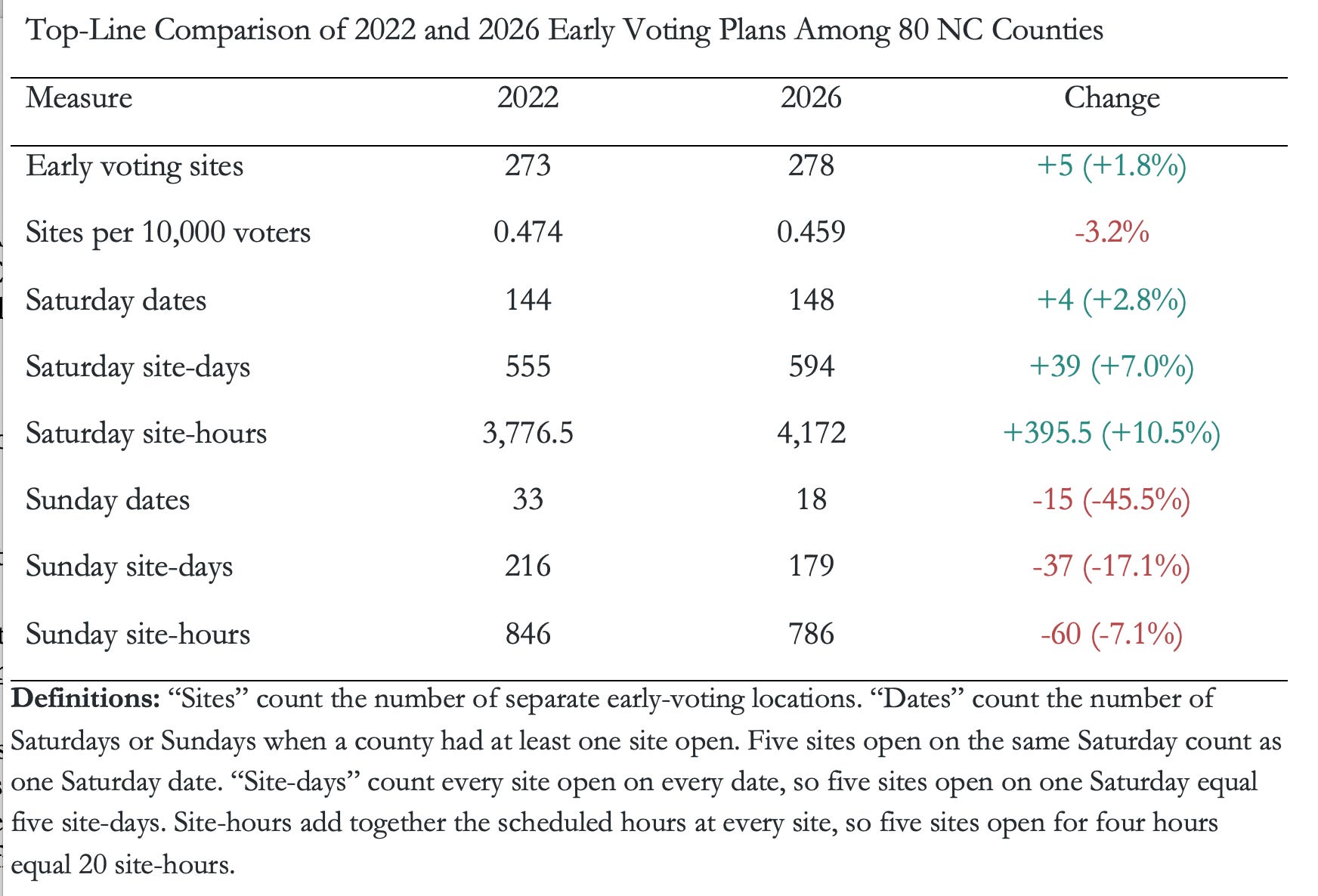
The total number of early voting sites in these 80 counties remained remarkably similar, increasing by just five, or 1.8 percent. But the state has grown since 2022, as has the number of registered voters. As a result, the number of sites per 10,000 registered voters has declined.
I measured Saturday and Sunday voting three ways: (1) dates (the number of Saturdays or Sundays when a county has at least one site open), (2) site-days (the total number of sites open across those dates), and (3) site-hours (the combined number of hours those sites are open).
Confused? That’s okay, because in this case the measurement doesn’t really matter. Regardless of the measure, these 80 counties will offer more Saturday voting and less Sunday voting in 2026 than they did in 2022.4
The specifics of Sunday voting reveal an even more striking story. None of the 80 counties added Sunday voting; twelve eliminated it altogether.5 This is similar to what I found in the 2026 primary plans, where no county added Sunday voting and nine eliminated it—even as the total number of sites increased by 6 percent.
A Geographic Shift
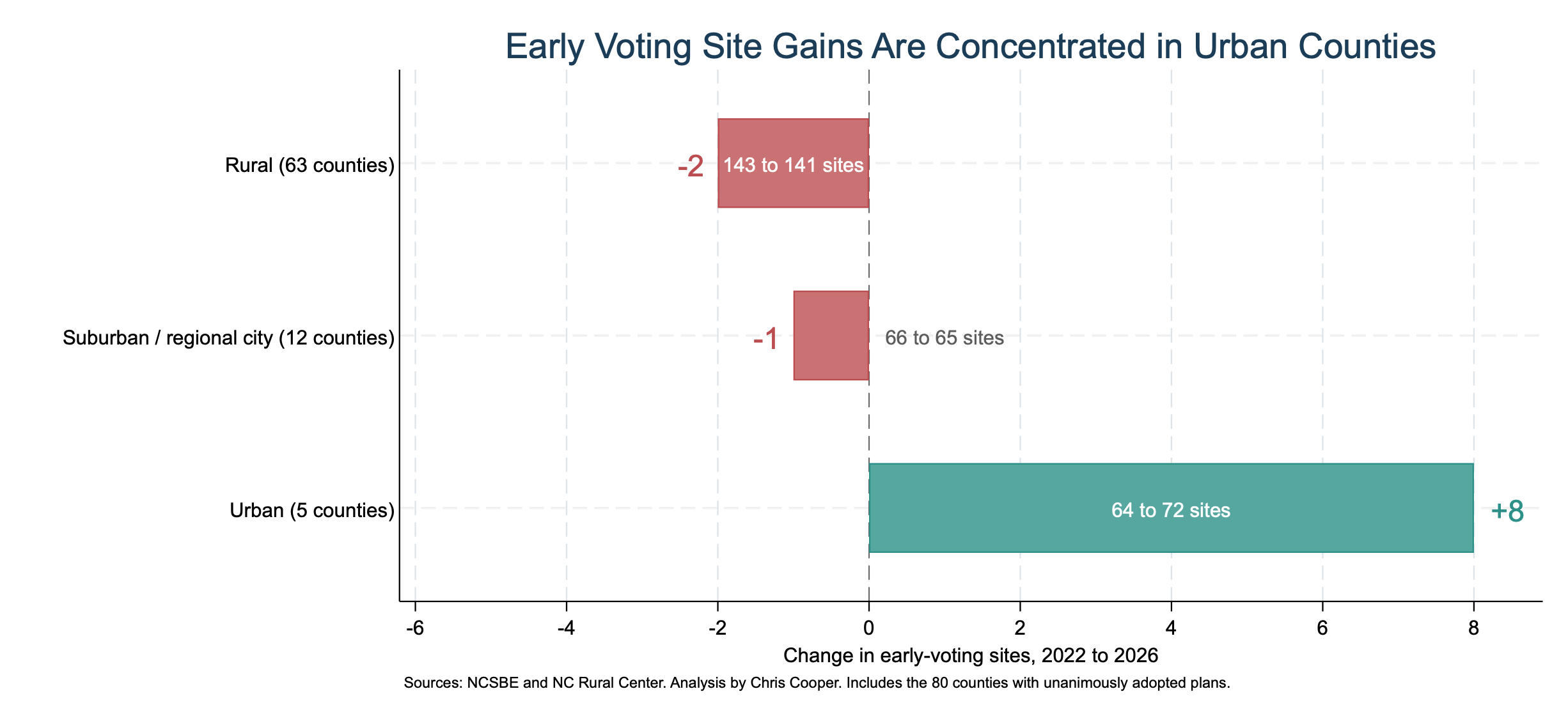
The timing of early voting isn’t the only thing that changed. There is an interesting geographic shift in where sites have increased and decreased.
The five urban counties gained eight sites, while the 63 rural counties lost two and the 12 suburban counties lost one. Sites per 10,000 registered voters increased 7.6 percent in urban counties but declined 5.7 percent in rural counties and 8.0 percent in suburban counties.
More to Come
It’s a complicated story, for sure. And we haven’t even gotten to the contested plans yet.
The State Board of Elections will decide those plans on August 20. I’ll analyze them as soon as I can get the data together.
There is some evidence to suggest that this effect is magnified among racial minorities.
I conducted a similar analysis after the 2026 primary election plans were finalized, although that one included all 100 counties. Expect a similar update once the 2026 general election decisions are final.
These data are harder to wrangle than you might think. For example, the official files list the same Swain County location twice under different names, reproduce Camden County’s entire 2022 schedule twice, and show two Lincoln County Sunday sessions running from 1:00 a.m. to 5:00 p.m. If you see any mistakes, let me know.
In a 2024 survey, Michael Bitzer asked North Carolinians about Sunday voting and found the following:
“When asked about the two Sundays occurring during early voting period, a majority—54 percent—of respondents said all 100 North Carolina counties should offer voting for each of the Sundays, while 31 percent said it should be left up to the individual counties if they should offer Sunday voting.
Among Democratic respondents, 72 percent said all 100 counties should offer voting on both Sundays, while only 37 percent of Republicans said so. Republican respondents had the largest percentage (29 percent) who said none of North Carolina’s counties should offer Sunday voting.”
The 12 counties that eliminated Sunday voting are Bladen, Brunswick, Cabarrus, Cleveland, Davidson, Duplin, Franklin, Lincoln, Moore, Pender, Richmond, and Sampson.